Friday, 6 July 2012

'AWNIOGO': BIGNALL END (A)


Bignall End and, behind it, the Cheshire Plain -- the second best view in North Staffs cricket...


Saturday, September 2

“And now, laaaaay-deeez ‘n’ gen-ul-men, it’s time for the main event…”

For such an important, top-of-the-table clash, it was surprising that Peter ‘Scoop’ Hewitt from the Evening Sentinel didn’t put in an appearance, especially since (a) neither side had been out of the top three since the turn of the season, and (b) neither side had yet played in one of said newspaper’s featured matches. This may sound elitist, but surely it is remiss that a team that has reached the last eight of the Staffordshire Cup, the last four of the Talbot Cup, and has spent all season around the top of Division 1, Section B should be considered unworthy of a featured match whereas the likes of Blurton, Fenton, Oulton, Oakamoor, Stanfields and ME-bloody-SC have their respective profiles boosted by highly flattering (and ever so slightly fabricated) accounts of high-calibre cricket matches.

I am not opposed to these clubs and their league receiving coverage in the local press, not at all, but why does it have to be at the expense of a more prestigious and higher standard competition. I mean, it’s not as if we can’t smear mud all over our pads, sport Burton’s menswear polyester shirts, pick the odd 65-year-old, field too close at mid-off whilst holding optional pint, score all our runs off the inside edge, not mow our outfield, draft in the local vicar for a spell of comedy medium-pace, cover our bats in thick insulation tape – you get the idea…

village: what the Sentinel readers had to put up with back then

Perhaps it was because of the onset of the football season that we would once again be absent from the Sentinel’s “comprehensive” sports pull-out, or perhaps it was down to the dismal weather on Saturday morning, weather that prompted my Dad to predict that we wouldn’t bowl a single ball. Well, by the time Mauler, Addo and I arrived at Boon Hill, the sun had got his hat on (hip-hip-hip hooray) and, despite the saturated outfield, it appeared that we would get an uninterrupted day’s play. The track looked like the mushy peas at my local chippy – soft, green, greasy – and was sure to offer considerable help to anyone who could hit the seam. So, it was good news when we won the toss and asked the leaders to have first use.

Addo elected to give the new ball duties to a combination of the wild and the wily – Shaun and Coke – and it was Barrington who made the initial inroads. Tim Myatt, Bignall End’s stoutly-built skipper, was the first casualty, fending a short ball ‘up the chimney’; despite being slow off the blocks and treading water (literally, on the sodden turf) for a few strides, I managed to gather just enough momentum to get to the rapidly dropping ball and, with a sprawling belly-flop, took the catch inches above the grass. My next victim was more straightforward as friend and team-mate of mine from University, Rob Howell, snicked a wider, quicker ball from Shaun. Mauler, freshly tanned after his fortnight in Ibiza, then replaced Shaun and immediately removed Dave Edwards, courtesy of an excellent slip catch from Addo. Clearly, Myatt’s bowling improved when his preparation was Mediterranean rather than subterranean.


HH: site of Myatt's subterranean preparation

Bignall End’s woeful start continued in the 17th over when ‘Big’ Eric Riley, so often a thorn in our side, mistimed by far Coke’s worst ball of the day to Harv at point to leave them on 25 for 4. It was Coke’s first wicket and well deserved after a typically accurate and probing spell. He was briefly rested to allow Iain Carr the benefit of the cross-breeze to assist his outswingers, but returned at the top end to snare another couple of wickets, including the crucial scalp of Nigel Nixon, leaving our opponents in the parlous position of 69 for 6.

Due to our habitually tardy over-rate, we were, at this point of the afternoon, caught between two stools: either go for the jugular, or send down some quick overs so as to leave ourselves longer to chase the target. Both strategies held clear risks, but I felt an ideal compromise would be for Addo to come on, since he would have been able to send down the quick overs, keep it tight and perhaps take the odd wicket on the slightly soft surface. However, Addo was convinced that it was a seamer’s pitch and that just about everybody else could do a better job than him. Was he hiding? Remembering the old maxim – the captain’s always right, even when he’s wrong – I decided not to force the issue.


Big End tea hut

As it transpired, Bignall End picked themselves up by the bootstraps and by tea had reached 137 for 7 from 51 overs. The only wicket we took during this period was that of Adrian Myatt (who I’d already caught off a no ball) for 43. During the interval, we seemed relatively content with our work, although recognizing that the final hour of the session was won by the home side. After tea, our grip on the match was loosened still further by a busy little partnership between Marcus Sharp and the younger Howell brother, Richard. Mainly through positive running, they added 63 vital runs together before Sharp fell to a direct hit from long off by Seth. His 43 helped Bignall End finish their 60 overs on 183 for 8, many more than they could have dreamt of at 3.00pm and certainly many more than I thought they should have been allowed to get.

At any rate, at the halfway stage it was four points apiece and we needed 184 at just over five per over to go top of the league – a stiff task, though not one that should have unnerved us unduly. There was little debate as to whether or not we should go for the runs, since there was no real danger of being bowled out in 36 overs…


'hitting the deck', Iain Vellocott

On a devilishly slow pitch we started the chase like a crippled tortoise, crawling to seven runs from the same number of overs. Addo was out of touch and struggling to get the ball away whilst I was getting bogged down by some unerringly accurate bowling from the 6’7” Cumberland and Minor Counties opening bowler, Marcus Sharp, who had packed the offside with seven fielders and didn’t bowl a single delivery on my side of the middle stump. By the eighth over I realized that we had to inject some urgency into our chase and, after slogging Nixon through mid-wicket, I profited from a half-volley and full toss to collect 12 runs in 3 balls.

Things were seemingly on the move, yet we only picked up 19 runs in the following seven overs, by which time the second bowler of a double change, Paul Johnson, had been introduced. I hit his second ball straight through our open dressing-room door for six, but was making the exact same journey a ball later when I mistimed a high full toss straight to mid-on.


home team dressing room door, centre

Harv came in at 45 for 1 in the final over before the last 20 and went on to play easily the best innings of the day. His 23-ball stay, during which he thumped the ball to all parts of the ground – and, on two occasions, out of it – brought us into serious contention. At 86 for 1 with 15 overs left we were beginning to dominate. Unfortunately, Dickie, whose whirlwind 40 constituted all but 3 runs of his partnership with Addo, then fell to a sharp yet contentious stumping by White just as he was about to go into Lara-mode. This dismissal opened the floodgates to a collapse of quite monumental proportions as 8 wickets tumbled in just 6 overs – I repeat: 8 wickets in 6 overs – for the addition of only 22 runs.

Addo was the third to go, the result of an increasing desperation that, if not evident when he asked to borrow Harv’s bat as he walked off, was certainly present in the shot that brought about his dismissal. After making only 11 from 55 balls, he top-edged a ball from Adrian Myatt straight up and Eric Riley took the catch at slip. Hawky was the third casualty of the over when he drove a full toss straight at Sharp, fielding at extra-cover. From a position of concern, Bignall End had, in the space of a six balls, bagged three prize wickets to seize control of the game and now had the bit firmly between their teeth. Their previously mute supporters had also unmuzzled themselves in growing anticipation of a previously unlikely victory.


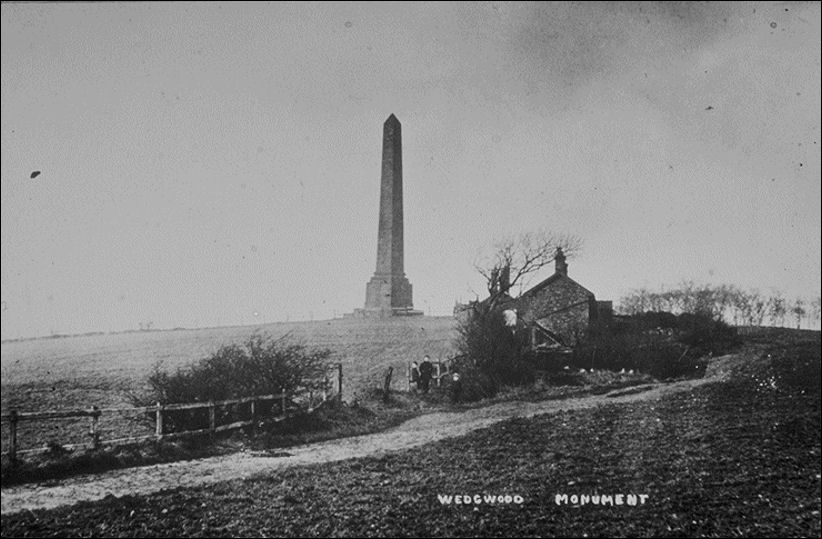
Wedgwood Monument, Red Street  -- overlooking Bignall End --
'castrated' by gales in 1976; were BE about to rediscover their virility


Sharp was recalled to the attack and immediately took the wicket of Mauler thanks to a catch of staggering brilliance in the gully by Edwards. We were in complete disarray. Iain Carr, who was due in at the fall of John’s wicket, was nowhere to be seen, whilst on the pitch Cokey was losing his off-stump thanks to a yorker from Sharp. Mayhem. Thankfully, Iain had turned up – he had been on the toilet – and walked out to join Drew at 99 for 6. However, in the very next over Billy was involved in two run outs as the chaos, the panic spread through our team. I was just stepping out of the shower when the first one occurred but if the expression on Drew’s face was anything to go by, I didn’t need to ask whose fault he thought it was. A couple of balls later Smudge was run out without facing a ball, getting completely covered in mud in the process, and he too was blaming Billy’s habit of relying on telepathic communication with his partner.

The braying home crowd was becoming extremely exuberant and slightly cocky, and this was beginning to grate with our small band of travelling supporters, particularly my father, who was involved in a discussion with one partisan and chauvinistic fan that came quite close to the line where banter meets hostility (not that Jim’s buttons are difficult to push in these situations). Drew, still smarting from his dismissal (it usually took 3 weeks), also found time to express one or two thoughts to a slightly obnoxious chap in a purple shellsuit, whilst I could only sing “We’ll support you ever more!”


'I Watched Every Ball',  Benjamin Toupein

Out on the field our situation deteriorated still further when Billy played a ludicrously aggressive shot in the circumstances and gloved a bouncer to Sharp at slip, prompting a stern word or two from his father, all of which meant that our last pair, Darren and Shaun, had to negotiate a further eight overs if we were to draw the game.

Shaun hung on gallantly whilst Darren protected him from Marcus Sharp, whom he was handling quite comfortably. After four overs without looking like getting the final wicket, skipper Tim Myatt (no relation) decided to bring on Nixon from Sharp’s end and allow the pro to switch to the other end where he might have a crack at Shaun. In theory the plan was successfully executed, but Shaun scuppered it immediately when he confidently pushed Sharp through the covers and escaped, as it were. Darren took care of the rest of the over, leaving us only 12 more balls to survive, albeit with Nixon bowling the penultimate over at Shaun. Just as I thought we had reached safety, Nixon produced a swinging yorker that proved too good for Shaun and Bignall End had won a game that they ought to have lost. Founder members of the NSSCL, they were now assured of promotion to Section A for the first time since the league took its present format in 1982, and looked likely to finish as champions.


Doc, 2004
As far as we were concerned, we needed to win two of our last three games to ensure a return to the top flight, having heard that Ashcombe Park had closed the gap to 23 points by inflicting a fourth consecutive defeat upon Newcastle, erstwhile contenders themselves. Our own post-mortem was full of premature pessimism and an unnecessary amount of bickering. Addo and Darren had a spat which ended with the latter refusing to play again after the skipper had questioned his attitude and desire.

Earlier in the day, I had made an unfair comment to Darren, in private, provoked by what I considered his unjust attitude towards my wicket-keeping. Whilst I accepted his analysis of my limited, patchy stumping skills, I also believed that his criticism completely undermined my attempts at doing a job which, originally, I only undertook temporarily to help out the side. I may sound like a whinging old goat (then again, it’s my book) but it pisses me off when people take cheap pot shots if I fumble a stumping or even just a take. It’s a difficult and demanding job, one that I would much rather not do, and one that people might appreciate more if they had to do themselves, particularly Darren, who seems to find it amusing every time the ball isn’t crisply gathered. “Grouty”, he calls me.

OK, I’ve got that little matter off my chest. Even so, I did say something wholly unreasonable which no doubt contributed to his totally misguided belief that I had put Addo up to saying what ultimately led to their argument. I think there is a personality clash and a misunderstanding of each other’s behaviour rather than any deep-rooted enmity, and the sooner it is resolved, the better, for all concerned.

Teams should pull together during the bad times, not disintegrate, which, at the time of writing, appeared to be happening to us. Harv, who not insignificantly was the only person drinking coca-cola rather than gallons of consolatory lager, summed it up perfectly when he stated that everyone was over-reacting to one defeat and one poor performance from the pro.


MODDERSHALL LOST BY 71 RUNS

BIGNALL END 183 for 8 innings closed (60 0vers)
M Sharp 43, A Myatt 43, Rich Howell 36*, N Nixon 31, K Colclough 3-68
MODDERSHALL 112 all out (34.3 overs)
R Harvey 40, S Oliver 32, A Myatt 4-27

MODDERSHALL 6 points
BIGNALL END 20 points 


Thursday, 5 July 2012

'AWNIOGO': ASHCOMBE PARK (H)

they came from Ashcombe Park


Saturday, August 26 

In the week leading up to the visit of third-placed Ashcombe Park, there was much discussion over whether we should look to face them on an under-prepared pitch and go flat out for victory or hedge against defeat by playing on one of our typically true Barnfields surfaces. The former strategy, similar to the one employed for the Bignall End fixture earlier in the season, was laden with unnecessary risk; after all, the emphasis was on Ashcombe (who trailed us by 32 points) to try and dictate the game. Thankfully, common sense prevailed and a relatively flat pitch was prepared. Nevertheless, ample midweek rainfall had given the wicket a greenish patina, enough to aid the accurate and persevering seamer. Otherwise, the wicket would be as we desired: good for batting with some encouragement for our spinners as the surface dried.

Given both the circumstances and the weather forecast (showers due late afternoon), it was something of a surprise that Joe Beech, the visiting skipper, decided to field first on winning the toss. Granted, the muggy conditions and green-topped track were ideally suited for their seamers, even without the steadying influence of Ian Wilson, but the threat of rain and the likelihood that we would bat them out of the game ought to have persuaded him to have been bold and batted first. 


In the face of some excellent bowling from the new-ball pairing of Terry Eyre and Dave Clowes, both of whom moved the ball around regularly and, at times, prodigiously, our start was steady, if unspectacular. It took Addo until the sixth over to get off the mark, which he achieved by taking 10 from a Terry Eyre over. However, ‘Tecker’ continued to bowl his probing leg-cutters and his consistency was eventually rewarded in the twelfth over with the prize scalp: Addo, bowled via his gloves for 15.

This wicket brought Smudge to the crease, elevated to number 3 in the order to give him a taste of the cut and thrust of first team cricket, and to see how he would fare in a different situation to that which he usually finds himself in, when he is often on a hiding to nothing. Smudger is a talented cricketer with a magnificent attitude and he fully deserved the opportunity to bat properly. Should he fail then there would be nothing lost, but if he were to hang around then he would probably score at a good rate (and gain some useful experience into the bargain). Some people thought that this promotion was patronising to Smudge and made him feel embarrassed walking out to bat before the likes of Harv and Hawk. This was rubbish. If it wasn’t felt that he could cut the mustard then he would have been playing in the Second Team; besides, nobody will ever be allowed to progress if their opportunities are dependant upon the notion of a hierarchy based upon reputation. In this particular context, Smudge’s promotion was both sound thinking and evidence of the skipper’s flexibility. As it transpired, he only scored 9 before edging Terry Eyre into the outstretched glove of Phil Hawkins behind the stumps. His dismissal was more the result of inexperience than any technical deficiency, as he played at a ball that he could have left, but I am sure he enjoyed his innings and it will have been an invaluable part of his learning process. 


English cricket and rain clouds: familiar friends

Dickie Harvey barely had time to settle in before the omnipresent black clouds opened and we were all running for cover, bizarrely stopping to take the refreshments that were half way on to the field! When the rain arrived, we were 81 for 2 from 26 overs with me ‘stranded’ on 49 not out. We were off the field for exactly an hour, during which time an early tea was taken. On resumption at 4.00 pm Ashcombe must have thought that their gamble to bowl first had backfired as, barring an enormous collapse, the game’s destiny was now completely in our hands. Our tactics were simple – to keep batting – and that is exactly what we did. Harv had a let off in the first over after the restart when he edged Clowes straight to second slip. However, Beech spilled the chance and Dickie didn’t look back.

I passed 50 from the first ball I faced after the delay with a back-foot drive for four off Clowes, and slowly but surely Harv and I began to get on top of the bowling. Clowes, who had shown a huge amount of potential despite struggling with a bruised toe, was replaced by Matt Colclough and Harv was soon punishing his all too frequent loose deliveries. At the other end I was profiting from batting with a left-hander as Eyre began to slide the odd ball on to my pads, gifts that I gratefully accepted. 


a young Oliver forces off the back foot

Just after our partnership had passed the century mark, Terry Eyre was rested and replaced by the rotund figure of Dave Butler, whose enigmatic little wobblers had accounted for Addison, Harvey and Myatt in the away fixture earlier in the season. His first delivery was greeted with a loud and rather unsubtle roar of laughter from Darren Carr in front of the pavilion, Doc no doubt having been filled in on Butler’s unexpected success in the aforementioned fixture. 

Anyway, Butler was soon receiving punishment as both Minty and I homed in on what seemed like inevitable centuries. However, in the 50th over, with the score on 199, I slog-swept the bowler to mid-wicket and was brilliantly caught by Willshaw, diving forward, having made a season’s best 89. With my demise, Harv continued to flay the bowling until he also holed out off Butler, this time to Salmon at deep square leg. His 93 – made from 111 balls, with 14 boundaries and a six – was also a season’s best. After a brief consultation, Addo and I decided, cautiously, to give ourselves 45 minutes and 20 overs’ bowling time, the declaration coming when Hawk, seemingly unsure as to our tactics, swatted Matt Colclough straight down Willshaw’s throat on the legside boundary. 

an exceptional catch on the legside boundary

With the declaration made, the question was whether Ashcombe would be bold enough to go for the target of 232 at around 7 runs per over. I felt they had little choice, since their season seemed to depend on it. Admittedly, it was not a particularly generous declaration; even so, it was almost identical, if slightly scaled down, to that which we had overhauled at Nantwich the previous week. It became apparent that Ashcombe intended to give it a shot when their prolific usual opening pair of Ross Salmon and Phil Hawkins was broken up to allow the freer-scoring Terry Eyre to open with Salmon.

Shaun Brian took the new ball under strict instructions to bowl off a shortened run and to pitch it up. He immediately got the ball to swing toward the slips – unfortunately, his second ball swung straight on to the middle of Salmon’s bat and flashed through point like an exocet missile. Undeterred, Moose continued to charge in and was rewarded with the wicket of Terry Eyre, for a golden duck, with the penultimate ball of his opening over. The fact that the mode of dismissal was caught behind and that I neglected to appeal probably explained the batsman’s disappointment with the decision!! 


Moose in his veteran years

Matt Colclough came out at number 3, struck his first ball past mid-on for four, and generally looked quite assured during a partnership of 71 in 13 overs with Salmon. All the major questions were being asked by Iain Carr, who was extracting steep bounce and on more than one occasion struck both batsmen painful blows on the gloves. In his sixth over, the final one before the last 20, Salmon struck him for a triplet of boundaries, sullying what had otherwise been a good spell. Iain was extremely dejected at being taken off, protesting “How am I supposed to get things right when I’m not given the chance?” While one could understand Iain’s frustration at not being rewarded with wickets, the fact was that the time and place to iron out kinks in one’s game is at practice, not on Saturday afternoon.

At the start of the last 20, with Ashcombe requiring 160 runs to win with 9 wickets in hand (At Nantwich the previous week, we required 169 with only 7 wickets in hand), Addo introduced himself and fellow spin twin Dazzra into the attack, keeping the field set back in the hope of buying a wicket or two. Lovejoy’s opening over was ordinary, both in terms of spin and direction, yet as is often the case this innocuous bowling picked up two good wickets. The first was Colclough, stupendously pouched at point by Drew, who had only just taken the field having earlier taken his daughter, Suzanne, to hospital with a suspected fracture of her right arm. (The happiest face on the ground upon Heardy’s return was unquestionably that of young Carl Colclough who, as our substitute fielder, had been jogging from fine leg to fine leg for a dozen overs.) 


the end of Salmon

Anyway, Drew’s brilliant catch was followed by another at mid-off by Smudge to account for Joe Beech, after which Ross Salmon was expertly held on the run, against all expectations, by Shaun Brian off Darren’s bowling, effectively ending the Park’s victory chances (they were now 86 for 4 with just 15 overs left) and allowing the ring of close catchers to concentrate on inventing new nicknames for our professional, which surely helped his bowling efforts. The latest offering is Wicksy (after Eastenders’ David Wicks), following Smudger’s brilliant recent coinage, Starsky. Lou Reed, Will Carling, Ray Platt, Mario Kempes, Kevin Keegan, Agile, Fragile, Lovejoy, Addo, Piggy – they all came out in a berserker frenzy of nomenclatural creativity.

It’s debatable whether Clowes’ concentration was disturbed by our jocularity or Addo/Lovejoy/Keegan/Kempes/Wicksy’s bowling, but he soon cracked under the strain and drove Starsky straight to Drew, fielding ‘in the box’ at short extra-cover. It was particularly ironic that he should be dismissed in this fashion only a couple of balls after I had turned to Hawk and Harv in the slips and asked “When does Addo ever get anyone out caught ‘in the box’?” Well, today he did, and Ashcombe were now in serious danger of defeat: with 10 overs remaining their last pair of recognised batsmen, Proffit and Hawkins, were at the crease, and should we be able to winkle either one of them out promptly, we knew we stood an outside chance of victory. 

Add0

We pushed hard, but as it was they batted well enough to snuff out that threat until ‘Jakey’ Hawkins was sharply caught at leg gulley by Darren off Coke’s bowling, by which time we had turned our attention to preventing the Park scoring the 125 they needed for a third batting bonus point. Entering the final over, they required a further 4 runs. Addo began the over with three maiden balls. Then Goodwin, the non-striker, was run out from the fourth ball thanks to some smart work from the Hawk-Addo combination as he tried to make his ground following an aborted quick single. Next ball, the game’s penultimate, Proffit sashayed down the track, swished, missed and the bails came off so quickly that our scorer entered ‘bowled Addison’ as the mode of dismissal, diddling me out of a victim: unbelievable!

With the last ball blocked, we left the field pleased with what had been a good performance. Ashcombe were all but resigned to another year in Section B, whilst we had closed the gap on Bignall End to a single point. Even before today, Newcastle were fast disappearing from the promotion picture and their third consecutive defeat, this time at the hands of Nantwich, left them with a mountain to climb, especially as they still had the other three top sides to play.

As we drank the night away, thoughts turned to next week and our crunch match with Bignall End. We had won on our last three visits to Boon Hill, and with Mauler returning from Ibiza, the question was: would the Evening Sentinel soon be forced to write more than one sentence about us?

MATCH DRAWN 


MODDERSHALL 231 for 5 dec. (56.4 overs) 

R Harvey 93, S Oliver 89
ASHCOMBE PARK 122 for 8 (32 overs) 

R Salmon 42, J Addison 4-17

MODDERSHALL 9 points
ASHCOMBE PARK 4 points


Wednesday, 4 July 2012

'AWNIOGO': NANTWICH (A)


Saturday August 19

Clambering out of the tardily-arriving Heardmobile at Nantwich, it was clear that we would again need plenty of Factor-15: the temperature, like Addo’s hairstyle, was firmly stuck in the 80’s. I suppose that Cokey, Bazzer, Drew, Tavs and all the other less young members of the first team squad can recall the famous Indian summer of 1976 when Viv Richards belted, tarmac melted, and milk curdled inside cows. Can it really have been as hot as this year?

With no time (or inclination) to warm up, I went for a quick browse of the wicket. The last time I played at Nantwich it was debatable whether the holes on the square were deeper than those in the adjoining cemetery, but this year they had obviously flooded it since, apart from the odd muddy looking wicket-end, it had a green tinge to the surface, probably an effort both to inject pace and to stop it from breaking up. However, we all felt that this appearance was misleading and that it would be slow and low, and so it proved when the first ball of the match – bowled by Shaun Brian after Addo had won the toss and elected to field – bounced about three yards in front of me and shot through for four byes. Lovely jubbly! When I had finished staring at my feet in dismay, I looked up to see Addo standing about fifteen yards away from me, glaring intently, brandishing a fist and clenching his teeth. I assumed that this gesture meant ‘come on Dog, get stuck in’, so I steeled myself for an afternoon spent trying to limit the damage on the most difficult pitch I would have to ‘keep on this season.

view across the square 

Nantwich got off to an excellent start, reaching 47 without loss in 10 overs. I didn’t think that either Billy or Barrington had bowled badly; it was a simple case of Nantwich capitalising fully upon the odd loose ball that was interspersed with the good stuff. Iain stuck to his task well and in the twelfth over was rewarded with his first wicket for a month when Lee Prince, who had not been batting as regally as his name suggests, slashed at a ball that was angled across him and offered me a simple catch.

The breakthrough brought to the crease the Nantwich professional, ex-Durham all- rounder Mark Briers. Last year Briers had played for Nantwich as an ‘amateur’ and finished second in the Section A bowling averages as well as topping the batting with an average of 87.2. However, as he was the professional for Cornwall at the time, the league deemed him to be an ineligible player and subsequently stripped Nantwich of all the points they had accrued in the matches in which he had appeared. This proved enough to send them down. 

Swanepoel -- but not the ex-Nantwich player, Adriaan
 
When their original professional, Adriaan Swanepoel, was forced to return to South Africa earlier this season due to a serious knee injury, Nantwich legitimately engaged Briers as a replacement, although it does seem a waste of money when Nantwich are not playing for anything because of their impending withdrawal from the league (a decision doubtless provoked by last year’s penalty). 

Anyhow, we were a little wary of his reputation before the game started but I reassured the lads by explaining that he couldn’t be any good as he had ginger hair. Good or no good, it was almost certainly his reputation that saved him from the embarrassment of a golden duck when a straight, full delivery struck him plumb on his front leg, barely six inches in front of the popping crease. Committed conspiracy theorist I may well be, but I am pretty sure that a lot of umpires are disinclined to give a professional or ‘big name’ player out early in an innings for the simple reason that they want to watch them bat! After this lucky escape, Briers went on to bat for over an hour, compiling 33 runs, all but one of which came in boundaries. Cokey’s nagging accuracy eventually forced him into a reckless shot and he was bowled.

By the time he had taken this wicket Cokey was bowling very tidily, fully exploiting the morsels of help that the track was offering him. He continued to forage away on off-stump or just outside, nipping the ball both ways, and he fully deserved the wicket of Davies who had spent 2 hours in making a scratchy, unconvincing 52. Having beaten his outside edge at least a dozen times, Coke finally got him to nick one and I was presented with another easy catch that left Nantwich on 137 for 3 as we took the second lot of drinks. 


Entering the session’s final hour, the game was intriguingly poised. We had only bowled 33 overs, so, rather than attacking, we had little choice but to send a few quick overs down. The two batsmen, Marsh and Symns, were playing in markedly contrasting styles against some probing spin from Addo and Harv, the latter of whom was looking uncannily like Cary Grant due to the sweat that had flattened and parted his usually rigid Barnet. Marsh was using the full extent of his considerable bulk to launch into anything even slightly over-pitched whilst, initially at least, Symns seemed happy to block. Then, suddenly, he sprinted down the pitch at Harv, missed, and gave me the chance to take off the bails, have a cup of tea, read the paper and recite the Lord’s Prayer all at the same time. It took me back to my days in the Staffordshire under-11s when many a batsman was dismissed by the same formula: stumped Oliver, bowled Harvey. This phrase has now found its permanent place in cricket’s Hall of Fame. 

Staffs U-11s: Old Trafford, 1984
(Harvey and Oliver at each end of front row)


The most noteworthy incident of this partnership took place not on the square but along the top boundary, in between the sightscreen and pavilion. As we toiled away beneath the sun’s unremitting rays in air so still it could have been an artist’s model, a bizarre, isolated wind picked up and blew along for what cannot have been more than fifteen seconds, swirling people’s hats into the air and knocking over a sturdy looking bench. Then, just as abruptly as it had appeared, it died out. ‘What in the name of Jesus H. Christ was that?’ I thought. It could have been some sort of supernatural energy-ball, or a poltergeist, or a small tornado, or even a particularly powerful bottom-burp. Cokey told everybody it was “just a twister” and reassured us all that it was nothing to panic about.

If that wasn’t sinister enough then, a little later, something even more extraordinary happened. No, Addo didn’t bowl an over without changing the field. About half-a-dozen overs before tea, Marsh drove Harv for a straight six into the graveyard at the bottom end of the ground. No doubt thinking about our sluggish over-rate, the umpire immediately reached into his pocket for the spare. Shaun Brian had not noticed this and was busy looking for the quickest way of entering the graveyard. Yet before he had chance to go and retrieve it, and before Harv could turn his arm over with the spare, the original ball flew back onto the outfield, apparently of its own accord. The immediate theory was that it had hit a gravestone and ricocheted back. This seemed implausible, a case of scared people trying to pacify themselves. The length of time between the ball disappearing over the hedge and re-appearing on to the outfield discounts this, unless it did a bit of pinball. It was definitely the result of paranormal activity. If there’s something weird / in your neighbourhood / who ya gonna call? / GHOSTBUSTERS! 


Bustin' makes me feel good

Anyway, in amongst the afternoon’s more surreal happenings, there was an important cricket match being played. By the tea interval Marsh and his skipper, Andy Newton, had taken the score to 213 for 4 from 51 overs. As we came off for some much needed refreshment one home supporter commented, rather loudly, “I don’t know how this lot are near the top of the league. We’re a much better side”. Could we make him eat those words?

A couple of our players rather naïvely thought that Nantwich would declare, if not at tea, then soon afterwards. I was sure they would use their full complement of overs, primarily because – let’s face it – it is more fun batting in hot weather than fielding. If that wasn’t reason enough then the fact that there was a smidgeon of animosity between the two sides, and that their pro was injured and unlikely to bowl, was certain to dissuade them from dangling any sort of carrot. Smudge wasn’t too thrilled at this prospect and threatened to “twat them” if they batted for the full 60 overs.

So, with a maximum of nine overs still to bowl, we took the field knowing that Nantwich could put the game out of our reach. We had to try and bowl these overs not only as quickly as possible, but also as economically. Marsh seemed eager to attack but was denied much of the strike by Newton who, unlike his more illustrious namesake, Sir Isaac, didn’t appreciate the gravity of the situation and just blocked out ball after ball, seemingly intent upon denying us bonus points at the expense of killing off the game. Meanwhile, our over-rate wasn’t helped by Drew who was carrying a bottle of frozen Tango around with him and thus wanted to field on the boundary at all times, even when the situation required him to come into the ring. Eventually we finished our overs having picked up one further wicket, that of Newton, who gloved a ball to slip off Addo that had, rather ominously, gone straight through the top. 

Sir Isaac 

We were left with the daunting task of having to score 250 to win in an hour and five minutes plus the last 20 overs. During the changeover the more experienced and level-headed members of the side were saying “let’s just get the 175”, whereas the more wildly optimistic among us were thinking solely in terms of victory. Admittedly, it was an improbable target, but definitely not impossible. Besides, when it comes to batting, we are, by nature, a cavalier side and will chase targets to the point of being suicidal. It was that method that had got us where we were. If it ain’t broke, don’t fix it. Cokey was so sure that this was a chase too far that he offered to eat my father’s sun hat if we won…

“Come on then Dog, it’s Dean and Cartledge time: shot-a-ball”, said Addo enthusiastically as we walked out to begin the chase. Well, I certainly obliged. The first ball I received, from French, the medium-paced left-armer, was shortish and angled across me. I slashed hard, got an edge, and was caught by Marsh at second slip for a golden duck. Well, I suppose if you’re going to get a blob then there’s no point hanging around all day for it!

With French bowling from one end, one would have expected Jennifer Saunders to be on at the other. Instead, it was the not-so-absolutely-fabulous Mark Symns who would try his luck, and in the seventh over of the innings he had Addo caught behind for 25 as he tried to cut a ball that was much too close. Next man in, Andy Hawkins, strode to the crease hoping to bat better than he had bowled, and joined Harv in an excellent little partnership of 45. During this stand, Nantwich had introduced Briers into the attack and he immediately settled into a rhythm, completely flummoxing Seth with his googly in an over that only cost a single run. Clearly we could not afford to get bogged down and it was fortunate for us that Briers, severely impeded by a groin strain, had to be withdrawn from the attack. 

not the Nantwich new-ball attack

As in so many other of our seat-of-the-pants run chases, we lost a crucial wicket just as it appeared that we had established a platform from which to push on. On this occasion it was Harv who fell, having made a fluent little 31. During a light-hearted net-practice in the week I had joked with Dickie that he couldn’t play off his legs (whilst he said that I could do nothing but!). Today he did nothing else but punch ball after ball through the on-side, making it quite tough to bowl at him. However, he tickled a regulation ball from Symns and was caught behind, once again succumbing in his thirties.

Harv’s dismissal came in the middle of a four-over period leading up to the final hour in which we scored only ten runs. This stutter left us requiring a mammoth 169 runs from 20 overs at nearly 8.5 runs per over, a task that no other side in the section would contemplate, especially with numbers 1, 2 and 3 sat in the hutch [how quickly Twenty20 would change perceptions in cricket – nevertheless, they had no obligation to have 4+2 in the circle]. If Nantwich were in any doubt as to our intentions, then 18 runs from the first two overs of the last 20 surely laid them to rest.

Having himself replaced Briers, Andy Newton brought on Marsh at the Cemetery End to replace the tiring Symns. This could have been a strategy to keep us interested in the chase – with the accompanying aim of buying a few cheap wickets – yet it had the unexpected effect of slowing down the run-rate as the hulking Marsh’s opening two overs of off-spin cost only 7 runs. In between times, Newton picked up the wicket of Iain Carr for 17 and suddenly the asking rate had soared to almost 10 per over.


scoreboard pressure at  Nantwich CC

Kev Colclough, who I had to coax into strapping on his pads, was sent in at number 6 in the hope that he could feast rather better on the fayre being offered out in the middle than he could on the sandwiches he was munching his way through. Armed with his trusty long-handled mooing-stick, Coke meandered out to battle and almost immediately began to wreak his own special brand of savagery: 45 runs were garnered from the next four overs as cultured strokeplay took a back seat to good, old-fashioned thuggery.

Still Newton and Marsh persevered. The latter, clubbed for 17 in his previous over, had an extremely vociferous appeal for a stumping against Cokey rejected but was brought off, along with his captain, with 8 overs remaining. At this point we still required 71 more runs and Newton decided to revert to his two opening bowlers in an attempt to split the dangerous combination of Coke and Hawk.

Having passed 50, Hawk had begun to play sublimely, mixing deft placement and aggressive running with shots of immense power, particularly his trademark slap-drive. Symns’ returning over only produced three runs as Coke struggled to adjust to the change of pace, and when the following over was rescued with a timely last-ball boundary it was evident that the pressure was still very much on us. We shall never know whether Andy was thinking along the lines of ‘All we need is one good over’, but clearly that was not going to be enough and it showed when he was bowled by Symns for a fine 83 as he tried to give himself room to launch another shot through the offside. 

Nantwich were crying out for Swanepoel
(not this one, Candice, but Adriaan, the ex-pro)
The man entrusted with the job of helping Coke to score 53 runs from the final 5 overs was Drew, who had sat patiently throughout Seth and Coke’s exhilarating stand of 88. The atmosphere on the pitch was electric, with Newton marshalling his now ragged troops as best he could in the face of the Moddershall onslaught. The tension amongst our players was also showing and the normally unflappable Barry Brian, due in next, said it was “enough to make him want to take up smoking”. It is a good sign when somebody can retain their sense of humour in the face of such pressure, but still, I suspected that the only two people actually enjoying themselves were Heardy and Cokey. 

French, the lesser of the two bowlers, conceded only three singles from his first three balls, but then Cokey inside-edged a four to fine-leg and hoisted the following delivery over wide long-on for six as the required run-rate came down to exactly 10 with four overs remaining. Symns did as best he could in the next over, keeping the ball pitched-up, but when Cokey managed to clear the boundary with a mistimed drive to bring up his first half-century of the campaign, it appeared that the momentum we had gained would prove decisive. However, again French began his over, the third last, with three miserly balls that yielded only a couple of singles. The balance of game was literally fluctuating with each delivery. We needed something special to prevent this over from fatally derailing the chase, but with the boundaries well protected and Cokey looking tired it was not going to be easy. We had recognised that Kev was exhausted and tried to get his inhaler out to him, if only to provide him with a chance to catch his breath. Cokey refused. Obviously he would have much preferred a pint.

Previously content to operate in singles and twos, giving Coke as much of the strike as possible, Drew realized that something more was required and that the onus was upon him to deliver it. Well, deliver he did as the next ball went soaring out of the ground. This was followed by a firm clip off his legs that the badly limping Briers was unable to prevent from crossing the boundary. They had been two marvellous shots in the context of the game, but the one that followed, from the final ball of the over, would have been brilliant in any situation. French cleverly bowled a slower ball, but Drew picked it and waited before sending an exquisitely timed extra-cover drive through the eye of a needle, tantalisingly close to three fielders who were all unable to stop it going for four. For the very first time in our innings the asking rate was less than a run-a-ball as just ten were required. Surely the game was won…


who, exactly, was telling this story?

Addo seemed to think so and he dashed off to the bar to order a couple of celebratory jugs of ale. Nantwich brought their fielders in, as they had to, but a further four runs were gleaned from the opening three deliveries of Symns’ last over. With 9 deliveries remaining we were now within one hit of victory. However, just when we thought that the plot had exhausted all its Hitchcockian twists, Drew, going for glory, holed out to Marsh, his old adversary, who had been posted at cow-corner by the scorebox, and then Cokey, now on strike having crossed with Drew, failed to score off the next two deliveries. Addo rushed into the bar and told the barman to put the jugs on hold!

So, six runs were required with six balls remaining. French, whose second spell figures of 3-0-38-0 had done as much as anything to put us in a winning position, was not entrusted with bowling the final, crucial over. Instead, Newton turned to what was his only realistic option: the wrist-spin of Briers. Bazzer, who was on strike, is renowned as an excellent player of fast bowling but not so great against the slow stuff. To counterbalance that weakness, he had proven himself, both at Crewe Rolls-Royce in the league and Newcastle in the Talbot Cup, to be a cool head in pressure situations. If he felt half as anxious as I did then he didn’t stand a chance.

When the field had finally been positioned, Briers hobbled in to bowl the first ball. It was short, Barry rocked back and cut it away through the infield for what should have been two runs. However, the ball evaded the man sweeping on the offside boundary and skipped merrily over the line for four. The ensuing roar was better than anything the Boothen End could have mustered, but then again there were a lot more of us! The next ball was again short but Bazzer failed to connect and no run was scored. Then, from the following delivery, Barry was bowled. Noooo!


Boothen End: original version

Smudge, the hero of our victory over Buxton, was sent out into familiar territory with about thirty pieces of well-intentioned if slightly contradictory advice swirling around his head. If he was feeling nervous it certainly didn’t show. Whilst he took guard and looked around I lit my umpteenth consecutive cigarette and crossed my fingers. Briers moved in, fired it in flat, and Smudge oinked it away over mid-wicket. He came back for two and the Chase of the Century had been won.

Cokey, who had made a season’s best 63 not out from only 42 balls including 5 fours and 4 sixes, just about summoned the energy to raise his willow wand as he marched off to a huge ovation. Smudge, grinning like a Cheshire Cat (although not one from Nantwich), could only ask of his winning blow, “Did it go for four?” Obviously he had decided that the best way of reading Briers was with both eyes closed. 

Cheshire Cat

Barely able to contain our euphoria, the re-ordered jugs were guzzled down with glee. The gentleman who had wondered how we were second in the league had got an emphatic answer, and superlatives abounded as to how good a win this had been. Graham Hawkins said it was the best run chase he had ever seen, and he has witnessed a fair few! The victory celebrations were even sweeter when we heard that Newcastle had lost to lowly Norton and fourth-placed Ashcombe Park had failed to knock off 174 against Burslem. Although Bignall End had beaten Barlaston to remain five points clear at the top, we were extremely comfortably placed 25 points in front of Newcastle and 32 ahead of our next opponents, Ashcombe Park.

This win was our tenth success of the season, beating our previous best of nine wins which we achieved both last season and in 1992, our promotion year. The omens were all good on the day that the greyhound had caught the hare.

MODDERSHALL WON BY 3 WICKETS

NANTWICH 249 for 5 innings closed (60 overs)
R Marsh 71*, O Davies 52, M Briers 33
MODDERSHALL 250 for 7 (35.4 overs)
A Hawkins 83, K Colclough 63*, R Harvey 31, M Symns 4-77
 
MODDERSHALL 20 points
NANTWICH 8 points 


'AWNIOGO': NORTON (H)


Saturday, August 12

With Bignall End meeting Ashcombe Park in what we hoped would be a no-score draw, we had the chance to close the gap at the top of the table by disposing of the crack outfit from Norton. We had two changes from the side that lost at Kidsgrove: Shaun Brian replaced his father (no pocket money for Shaun this week) whilst Drew, having returned from Spain with an ear infection allegedly caused by two kids constantly nagging him for some “petaters”, came in for Cokey, the latter having gone to Wales.

Mick Caddie, the diminutive Norton skipper, called correctly at the toss and asked us to bat despite his best bowler having still to arrive. Runs flowed freely at the start of our innings as I got served the lion’s share of the freebies and tucked in heartily, hitting 10 boundaries on my way to a half-century, made from 51 balls. A ton was there for the taking (by someone else of course, because I have a negligible amount of self-control and was bound to play the Kamikaze shot I did, getting out caught at cover with the score on 91). 

what  Heardy had been spending 

Hussein, the slow left-armer who dismissed me, had obviously parked his sled and reindeers up the road somewhere, as only Santa Claus could have brought as many gifts as he did. Minty unwrapped his own presents, three full-tosses and a long-hop, in the space of one over, but this was clearly a ploy to lure him into complacency mode and he was soon trapped lbw by Les Sherratt, who had taken a day off from his preferred hobby of trainspotting. Both Harv and I learned a valuable lesson about complacency and as Dickie trudged off ruefully we found ourselves at 141 for 2 from 30 overs and really needing to press on and declare, for obvious reasons.

Addo had been batting like the West Indians in the Trent Bridge Test Match – unfortunately he was closer to Sherwin Campbell’s five-hour 40-odd than Lara’s quickfire century – and was on the verge of being slow hand-clapped when a change of bats also brought about a change in tempo. Having spent two hours reaching his half-century, he started to flay the bowling to all points of the compass, prompting Mauler to do likewise. Together they added 99 runs in 12 overs whilst I fantasized about the merits of backyard cricket, where the more batsman-friendly rules allow you to have at least one chance before you are dismissed. Those were the days… Instead of being out in the middle scoring runs, I spent the afternoon triple-jumping on the boundary with Wayne and Drew whilst reading them passages from an essay on the German existentialist philosopher Martin Heidegger’s Being and Nothingness, which I’m sure they enjoyed! 

Heidegger: possibly a Nazi

The declaration came at 4.30, after Mauler had clubbed Sherratt for 24 in an over to bring up his own 50 and the bowler’s ton. It was Mauler’s third half-century of the season and took only 32 balls, 21 of which were spent getting into double figures. Whether Addo realized it or not, his declaration left him stranded 8 runs short of what would have been his fourth century of the season, but it was the correct decision. For Norton to knock off the 240 runs, we reckoned, Mick Caddie would have to make about half of them. Whilst he is a useful and dangerous player (in fact his colleague and drinking partner, Iain Wain, considers him to be “the best batsman in the league” – I jest not!), he is over-reliant on a good eye and will always give the fielding side a chance. Darren claimed we had nothing to fear from a man who shares his seven-year-old son’s kit. 

As usual we bowled like drones to begin with, allowing 40 runs to be scored in the opening 8 overs, before Shaun Brian bowled Griffiths with an off-cutter. Caddie meanwhile vas playing a shot-a-ball and raced to fifty by clipping Mauler, who had replaced Iain Carr at the Pavilion End, through square-leg. However, John did get some reward when he forced West into nicking behind to leave Norton on 57 for 2. The incoming batsman, Richard Slater, looked tentative at first but then gave Caddie good assistance in a stand of 40.


Norton all-rounders ain't what they used to be...

Just as a glimmer of light was starting to appear for Norton we snuffed it out by taking three quick wickets that plunged them into deep trouble. Caddie led the procession as he scooped Wayne straight to Addo at mid-wicket. Wayne then trapped Clowes in front with a boomerang of an inswinger, before he returned Addo’s favour by taking a sharp chance at silly-point to remove Slater. With the scoreboard reading 102 for 5, victory would have been a formality but for the rare and unexpected appearance of rain. It was Sod’s Law that the first league match to be interrupted by the weather since June 10th had to be against Norton, of all sides, and just as we were moving in for the kill.

The light spots that had been falling for about ten minutes grew into a steady drizzle, and at 6.30 the umpires had no choice but to leave the field. The covers were pushed on (by everyone except Lovejoy and Mauler, who pleaded that there was a rule allowing pro’s and ex-pro’s to excuse themselves from this chore) and we retired to the dressing room waiting for the black clouds to blow over. The omens were especially bad, though, as Drew had confidently predicted that it would stop quite soon, and as everybody knows Heardy’s meteorological forecasting leaves a lot to be desired.


Fishy forecasting

As the rain came down, we tried to keep ourselves occupied in our own various ways: Addo smoked, Shaun climbed up things, Hawk strolled around, Drew stared dolefully up at the skies, Iain Carr went in search of Bernie, Smudge told everybody about the Cosworth he overtook the night before, I read my book, and Daz and Harv started flinging a cricket ball around the dressing room very hard. Apart from being annoying, this was also dangerous if you weren’t watching the ball, so I found them a sponge ball to use instead. Soon there was a full-scale volleyball match in progress and I decided, after my second blow to the face, that the only way I could go on reading was by putting on my helmet. Sure enough I was still being disturbed so I sat inside my coffin and attempted to ignore them. I had just got comfortable when Wayne crouched over me and farted into my grille, at which point I left…

Just before 7 o’clock, the rain subsided to a barely noticeable spit, but the umpires, bound by regulations, could not restart play until it had stopped completely. Thankfully, this happened to be at 7.20 pm, by which time we were left with 15.3 overs to take the last five wickets, a task that could well prove tricky with a damp ball.


Wayne Stones looking pleased with his bowling form 

Wayne, returning at the Road End to finish the over he had started almost an hour earlier, got things off to a brilliant start when he found the edge of Wain’s bat and presented me with a second easy catch. In his next over Bart struck again, clean bowling Willshaw with a yorker. His five-wicket haul, taken in only 23 balls at a cost of 8 runs, was completed an over later when Sherratt fended off a surprise bouncer straight to Darren Carr at second slip. Norton had crashed from 97 for 2 to 117 for 8, leaving us 70 deliveries to claim the last two wickets.

However, things became complicated when Howard and Hussein stuck around for over six overs, so Addo decided to take Wayne off and replace him with Barrington Brian’s extra pace. Considering Shaun’s erratic opening burst it was a calculated risk, but the gamble paid off when he castled Hussein with only his third ball. We knew victory was in the bag when Landon, the number 11, walked out to bat chewing on a carrot and Howard clearly didn’t trust his partner either as he flashed hard at Shaun allowing Hawk to take a fittingly brilliant catch at third slip. The 20 points hoisted us back into second place, above Newcastle, who had lost to Kidsgrove. We were now only 5 points behind Bignall End, who could only glean 2 points from their game with Ashcombe. Going into the final six games, consensus was that we were confident of promotion providing we won our fair share of tosses. It was certainly going to be close, but then again, walkovers are no fun at all.


MODDERSHALL WON BY 89 RUNS 


MODDERSHALL 240 for 2 dec. (42 overs)
J Addison 92*, S Oliver 51, J Myatt 50*, R Harvey 33
NORTON 151 all out (34.1 overs)
M Caddie 63, W Stones 5-25, S Brian 3-3 1


MODDERSHALL 20 points
NORTON 5 points